Kashmir Social Fabric Under Pressure: Who Cast the Evil Eye on the Valley?
By: Javid Amin | 20 September 2026
From extravagant weddings and family-court battles to unemployment, trafficking and mental-health concerns, Kashmir is confronting a difficult question: what is happening to the social fabric of the Valley?
There is a question increasingly being whispered across Kashmir, sometimes in drawing rooms, sometimes over tea, sometimes after a family dispute and sometimes after another troubling story appears on a mobile phone.
What happened to us?
The question is not really about politics.
It is about families.
About marriages that begin with days of celebration but can end in bitter litigation. About parents and children who once shared a home but now find themselves on opposite sides of a legal dispute. About young people who spend years preparing for government examinations because employment has become a measure of social worth. About families borrowing money to meet expectations surrounding weddings. About women caught in coercive marriages. About trafficking, addiction, anxiety and the quiet distress that rarely reaches the headlines.
Kashmir has changed enormously over the past several decades.
Some of that change has brought opportunity. Education has expanded. Connectivity has improved. Young Kashmiris have entered professions and markets that previous generations could scarcely imagine. Women have entered new educational and professional spaces. Tourism, entrepreneurship and digital businesses have created new possibilities.
But change has also produced friction.
The old social order has not disappeared, yet the new one has not fully settled either.
The result is a Valley negotiating between tradition and aspiration, family authority and individual choice, community life and consumer culture, economic security and uncertainty.
Perhaps that is the real meaning behind the question:
Who cast the evil eye on Kashmir?
There may be no single answer.
When a Wedding Lasts Longer Than the Marriage
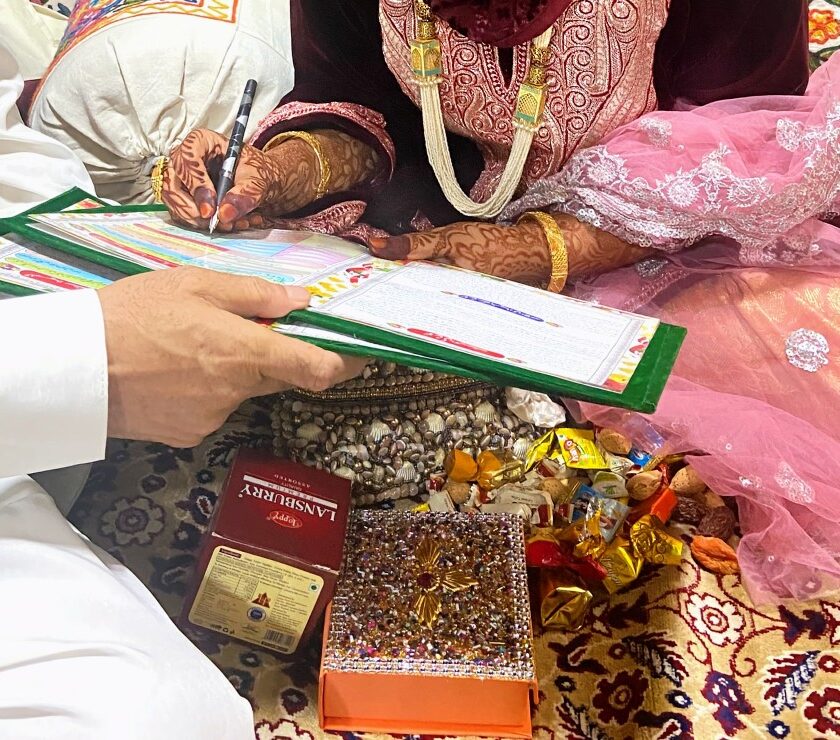
In Kashmir, marriage has never been merely a private agreement between two individuals.
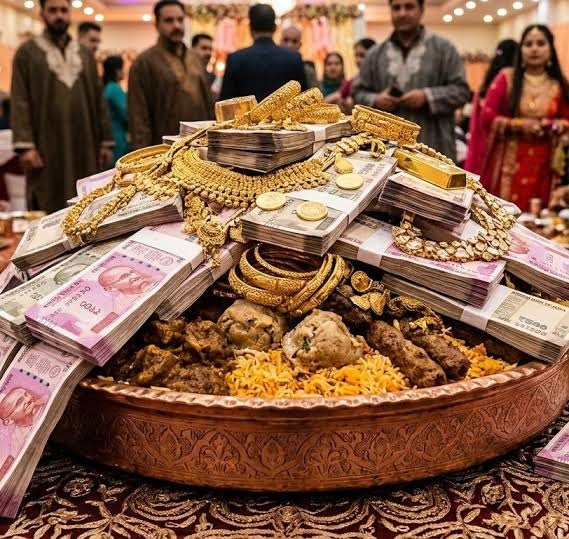
It brings families together, creates new relationships and carries enormous social significance. The wedding itself can involve months of preparation, substantial expenditure and the participation of hundreds of relatives, friends and neighbours.
But behind the celebration is another reality.
The financial burden of marriage has become an increasingly important subject of research.
A 2026 study published in the International Journal of Law, Policy and the Family examined changing marriage practices in the Kashmir Valley through interviews and focus-group discussions with 46 recently married and unmarried people. The researchers identified financial pressure, delayed marriages, unemployment and changing family expectations as major themes. They also documented the emergence of mass marriages as a response to the cost of conventional weddings.
The finding is significant because it shifts the discussion away from gossip about individual marriages and towards a much larger social question.
What does marriage cost a Kashmiri family today?
The answer is not limited to the wedding bill.
There is the venue.
The food.
The clothes.
Jewellery.
Photography.
Transportation.
Gifts.
Accommodation for guests.
And, increasingly, the pressure to make the entire event look prosperous.
A wedding can become a public statement about the family’s economic position.
That pressure is visible in contemporary discussions about log kya kahenge, or “what will people say?” A recent Kashmir Life commentary described social approval as an increasingly expensive force influencing weddings, homes, education, cars and other visible markers of status.
The danger comes when social approval becomes more important than financial reality.
A family that cannot afford an extravagant wedding may still feel compelled to stage one.
A family that chooses simplicity may fear being judged.
And a young couple may enter married life carrying financial expectations that existed before they had even begun building their relationship.
When the Marriage Enters the Courtroom
The most visible sign of marital breakdown is often not the separation itself.
It is what comes afterwards.
Recent proceedings before the Jammu and Kashmir and Ladakh High Court offer a window into the complexity of family disputes in the Valley.
In August 2026, the High Court considered a custody dispute involving a couple whose marriage had been dissolved by a family court in Qatar. The couple’s two children were subsequently brought to India, and the dispute continued over their custody and access. The High Court examined the circumstances and fashioned an interim arrangement concerning the children’s contact with both parents.
The details are complicated, but the underlying issue is remarkably simple.
A marriage may end between two adults.
Parenthood does not.
The same court has dealt with other disputes in which children became central to prolonged matrimonial litigation. The cases show how quickly a private disagreement between spouses can expand into questions involving custody, maintenance, travel, education and the emotional welfare of children.
Another September 2026 High Court proceeding recorded how matrimonial litigation had led to a criminal case before the parties eventually reached an out-of-court settlement.
These cases should not be read as proof that divorce has suddenly become widespread in Kashmir.
Court records cannot establish such a conclusion.
What they do show is that when marriages break down, the consequences can become complicated enough to require prolonged intervention from the legal system.
And once lawyers and judges enter the picture, the conflict rarely remains confined to the couple.
Parents take sides.
Siblings become intermediaries.
Grandparents become caregivers.
Children can find themselves navigating two households and two competing narratives about their own family.
That is a profound change in the way a community manages marital conflict.
The Ten-Day Wedding Story and the Larger Anxiety Behind It
Stories of marriages collapsing within days or weeks can travel rapidly through Kashmir’s social networks.
A grand wedding followed by an abrupt separation makes for a particularly powerful story because it appears to compress an entire social contradiction into a few days: enormous attention to the wedding, followed by an inability to sustain the marriage.
Such accounts should not automatically be turned into statistics.
But their popularity reveals something about public anxiety.
People are increasingly asking whether young couples are adequately prepared for marriage.
Are they choosing each other, or are families choosing for them?
Are expectations being discussed before the wedding?
Are financial responsibilities understood?
Are career plans compatible?
Are families prepared to respect boundaries?
Are young women and men being given enough space to make informed decisions?
Recent academic research adds another dimension.
A 2026 study by researchers from the University of Kashmir examined forced marriage among women in Ganderbal. Based on qualitative interviews with 15 respondents, the research documented concerns including loss of autonomy, reproductive-health consequences, social stigma and restrictions on personal choice and healthcare.
That is a very different problem from an extravagant wedding.
But both point towards the same underlying issue.
Marriage is changing.
Young Kashmiris are increasingly exposed to ideas about individual choice, education, employment, gender equality and personal autonomy, while traditional family structures and expectations remain powerful.
The resulting tension can be difficult to manage.
Two Kashmirs Are Meeting Inside the Same Household
For generations, the social contract was relatively clear.
Study hard.
Find a respectable job.
Get married.
Build a house.
Raise children.
Maintain the family’s reputation.
But today’s young Kashmiris have a much wider horizon.
They see careers abroad.
They see entrepreneurship.
They see influencers.
They see women pursuing professions.
They see people delaying marriage.
They see relationships discussed openly online.
They see lifestyles that would have been unfamiliar to their parents.
This does not mean young people have abandoned tradition.
Far from it.
It means they are negotiating tradition differently.
A parent may ask, “What will people say?”
A son or daughter may respond, “But what do I want?”
That conversation can be difficult when both sides believe they are protecting the family’s future.
The Employment Question Is Also a Family Question
Behind many of these social tensions sits a less glamorous but enormously important issue: employment.
Government employment has historically carried exceptional prestige in Kashmir.
A government job means income, stability and social respect. In many families, it can also influence marriage prospects and perceptions of status.
That helps explain why unemployment among young people is more than an economic statistic.
It can become a family concern.
The latest J&K Economic Survey reports that the Union Territory’s overall unemployment rate under the usual-status measure fell from 6.7% in 2019-20 to 6.1% in 2023-24. It also records an increase in the labour-force participation rate from 56.3% to 64.3% during the same period.
Those figures show improvement in several labour-market indicators.
But improvement at the aggregate level does not eliminate the frustration experienced by young people competing for limited formal-sector opportunities.
The same Economic Survey notes the government’s focus on unemployment, underemployment, skill mismatches, entrepreneurship and self-employment.
That is important because Kashmir’s employment challenge cannot be solved simply by producing more government vacancies.
The economy needs multiple pathways.
Technology.
Tourism.
Agriculture and horticulture.
Construction.
Manufacturing.
Services.
Creative industries.
Small businesses.
Entrepreneurship.
Skilled trades.
The social challenge is to make those careers respectable too.
A society that tells every educated young person that success means securing a government post creates a queue that no government can possibly absorb.
The Social Cost of Economic Insecurity
Economic insecurity does not stay inside the employment department.
It follows people home.
A young man without stable work may delay marriage.
A young woman may face pressure to prioritise marriage over employment.
Parents may continue supporting competitive-exam preparation for years.
Families may borrow to fund education or weddings.
And when expectations collide with reality, frustration can spill into relationships.
This is why unemployment should not be discussed only in terms of percentages.
It is also about dignity.
It is about whether a young person believes there is a meaningful place for them in society.
The Suicide Debate Needs Facts, Not Panic
Suicide is another area where public discussion can easily outrun the evidence.
It would be inaccurate to say that official data shows an uninterrupted rise in suicides in Jammu and Kashmir.
The available NCRB-linked figures reported for 2024 indicate that J&K recorded fewer suicide deaths than in 2023.
That does not make the underlying mental-health question less serious.
A suicide statistic records an outcome.
It does not capture every person struggling with depression, anxiety, loneliness, family conflict, addiction or suicidal thoughts.
Research among young people in Jammu and Kashmir has found relationships between social support, resilience, well-being and mental-health outcomes. That matters because it suggests that social connection is not simply a cultural luxury. It can be part of the protective environment around vulnerable people.
The lesson is therefore not to declare a “suicide epidemic” without evidence.
It is to recognise that mental-health distress can exist long before it becomes visible in official statistics.
When Silence Becomes Part of the Problem
Kashmir has strong family and community structures.
But those same structures can sometimes make difficult conversations harder.
Mental illness can carry stigma.
Marital problems can be hidden to protect family reputation.
Women may fear social consequences if they speak openly about abuse or coercion.
Men may be reluctant to acknowledge emotional distress.
Parents may interpret depression as laziness.
Young people may fear disappointing their families.
And a family may spend enormous effort protecting its reputation while failing to ask the person at the centre of the crisis what is actually happening.
This is where the old phrase log kya kahenge becomes more than a cultural expression.
It can become a barrier to seeking help.
The Darker Side: Trafficking and Exploitation
Then there is a problem that cannot be explained simply as cultural change.
Human trafficking and exploitation are criminal realities.
Jammu and Kashmir Police have documented trafficking-related operations in the Valley, including a 2024 Baramulla case in which four minor girls were rescued from an alleged trafficking module.
In May 2025, Baramulla Police also announced the arrest of four people in an alleged immoral-trafficking racket in the Kunzer area.
The existence of such cases does not justify describing Kashmir as a centre of a widespread “flesh trade”.
That would turn individual criminal cases into a sweeping social label.
The more important point is that vulnerable people can be exploited when poverty, migration, unemployment, deception and weak oversight intersect.
The Ministry of Home Affairs has also directed states and Union Territories to strengthen Anti-Human Trafficking Units and has emphasised immediate registration and investigation of complaints involving missing children, with an initial presumption of abduction or trafficking unless investigation establishes otherwise.
J&K Police maintains Anti-Human Trafficking Units in several districts, including Srinagar, Baramulla, Anantnag and Jammu.
The challenge is not simply catching traffickers.
It is preventing vulnerability from becoming an opportunity for traffickers in the first place.
Consumer Culture Has Changed the Meaning of Status
Kashmir’s economic transformation has brought undeniable benefits.
People have greater access to goods, services, technology and information.
But prosperity can create its own social pressures.
The question is no longer only whether a family can afford something.
It is whether it can afford not to have it.
A better car.
A larger house.
A more expensive wedding.
A foreign holiday.
A fashionable wardrobe.
A child’s expensive education.
The problem is not consumption itself.
It is comparison.
Social media has turned comparison into a continuous process.
A person no longer compares their life only with the neighbour next door.
They compare it with hundreds of carefully edited lives appearing on a phone screen every day.
That can produce a peculiar kind of dissatisfaction.
The person may be doing reasonably well.
But someone else always appears to be doing better.
Even Tradition Is Changing
There is another irony here.
Consumer culture has not simply replaced Kashmiri tradition.
It has commercialised parts of it.
Wazwan remains an important symbol of Kashmiri hospitality and identity, but contemporary food culture increasingly exists alongside restaurants, events, tourism and social-media presentation.
The same thing is happening with weddings.
Traditional elements remain.
The presentation changes.
This is not necessarily cultural destruction.
Culture has always evolved.
The question is what happens when the performance becomes more important than the meaning.
The Conflict Legacy Cannot Be Ignored
No serious account of Kashmir’s social transformation can leave out decades of conflict.
The conflict years altered family structures, public life, education, migration patterns, economic opportunities and perceptions of security.
They also left psychological scars that cannot be measured only through employment or income statistics.
Research on changing public spaces in Srinagar has examined how years of conflict contributed to a contraction of public life and how newer consumer spaces have provided young people, including women, with alternative places for interaction and expression.
But conflict cannot be used as a universal explanation for every problem facing Kashmir today.
A society that is changing because of globalisation, smartphones, education, urbanisation, economic aspirations and changing gender relations cannot be understood through one lens.
Kashmir’s current social transition is the product of several forces operating simultaneously.
What Happened to the Neighbourhood?
Perhaps the biggest change is also the least measurable.
The neighbourhood.
Older Kashmiri life relied heavily on informal networks.
Neighbours knew one another.
Extended families lived close together.
Elders often mediated disputes.
Religious institutions were social as well as spiritual spaces.
A wedding involved the neighbourhood.
A death brought neighbours together.
A sick family rarely remained entirely alone.
Modern life has not erased these relationships.
But it has put pressure on them.
Families have become smaller.
People migrate.
Urban life is more anonymous.
Work consumes more time.
Digital communication competes with physical interaction.
And private problems increasingly remain private until they become crises.
The result is a paradox.
People may have more ways to communicate than ever before.
Yet some may have fewer people with whom they can speak honestly.
Who Is Responsible?
This is where the easy answers begin to fail.
It is tempting to blame parents.
Or young people.
Or social media.
Or capitalism.
Or political conflict.
Or government institutions.
Each explanation captures part of the picture.
None captures all of it.
Parents can impose excessive expectations.
Young people can become trapped in comparison and consumerism.
Institutions can fail to provide adequate mental-health, employment or social support.
Families can hide problems because of reputation.
Criminal networks can exploit vulnerable people.
And the long legacy of conflict has shaped how generations understand security, trust and public life.
The responsibility is therefore distributed.
That does not mean nobody is accountable.
It means accountability has to exist at several levels.
What Kashmir Can Still Repair
The Valley does not need to return to an imagined perfect past.
That past never existed.
Older Kashmir had its own inequalities, restrictions and silences.
Women faced social limitations.
Mental-health problems were often hidden.
Domestic abuse could remain behind closed doors.
Young people had fewer choices.
The task is not to recreate yesterday.
It is to preserve the strongest parts of community life while building institutions suited to today’s realities.
Mental-health support must become ordinary
Counselling should not be something a family seeks only when a crisis becomes unbearable. Schools, colleges, hospitals and workplaces need accessible support systems.
Employment must become broader than government recruitment
The government itself recognises the need to address unemployment, underemployment, skill mismatch and entrepreneurship. The next step is cultural as much as economic: skilled private-sector work and entrepreneurship must carry social respect.
Marriage needs preparation, not merely celebration
Young couples need conversations about finances, careers, expectations, household responsibilities, children and boundaries before the wedding, not after the first major disagreement.
Simplicity should not become a source of shame
If families want smaller weddings, they should not have to defend that choice.
A simple wedding should mean exactly that: simple.
Not unsuccessful.
Children must remain outside adult warfare
The recent custody cases before the High Court show why the child’s welfare has to remain central when marriages break down.
Trafficking requires prevention as well as prosecution
Police action is essential, but so are safe employment channels, regulation of placement agencies, awareness among vulnerable families and rehabilitation for survivors.
Community spaces need to return
Libraries, sports grounds, cultural centres, schools, mosques and neighbourhood organisations can provide something that social media cannot: genuine human connection.
Kashmir Is Not Losing Its Soul. It Is Negotiating Its Future.
It would be easy to write a dramatic story about a society in collapse.
The evidence is more complicated.
Kashmir is not a society without values.
It is a society negotiating between competing values.
Collective responsibility and individual freedom.
Tradition and modernity.
Simplicity and status.
Family authority and personal choice.
Economic aspiration and financial reality.
Privacy and public visibility.
The same Valley that produces extravagant weddings also produces campaigns for simpler marriages.
The same society struggling with family disputes still relies heavily on extended family networks.
The same young generation frustrated by unemployment is also building businesses, entering new professions and seeking opportunities beyond government employment.
The same community worried about cultural erosion continues to preserve language, literature, food, music and religious traditions.
That is why the phrase “social collapse” is too easy.
What Kashmir is experiencing is better understood as a social transition under pressure.
And transitions can go in different directions.
The question is which direction the Valley chooses.
Perhaps parents will learn to listen before deciding.
Perhaps young people will learn that social-media lifestyles are not measures of personal worth.
Perhaps marriages will be judged less by the size of the wedding and more by the strength of the relationship.
Perhaps a government job will become one career among many rather than the definition of success.
Perhaps mental-health support will become as ordinary as medical treatment.
Perhaps communities will intervene before private problems become public tragedies.
And perhaps the next generation will ask a different question from the one that has dominated Kashmiri social life for decades.
Not:
“What will people say?”
But:
“What does this person need?”
That could be the beginning of repair.
Because if there is an evil eye on Kashmir’s social fabric, it is unlikely to belong to one person, one institution or one era.
It is more likely to be found in the accumulation of small pressures: status over substance, silence over conversation, appearance over wellbeing, competition over community and fear over trust.
The good news is that none of these forces is irreversible.
The Valley has changed before.
It will change again.
The real question is whether Kashmir’s people can carry its strongest tradition into that future: the simple idea that a person’s suffering is never entirely their own.
And that sometimes, saving a society begins with saving the person standing quietly in front of us.